
raw vision issue no 127 summer 2026
Review by Outsider art expert colin rhodes
"Scrupulously researched, thoroughly readable and richly illustrated biography of Alfred Wallis"
RAWREVIEWS — BOOKS
ALFRED WALLIS: CHILD PAUPER TO ARTISTIC LUMINARY
by Matilda Webb
Seadrift Press, 2025
ISBN: 978-1838414207
It is impossible to open a book about art in the small fishing port of St Ives, Cornwall, without encountering the work of Alfred Wallis (1855–1942). St Ives has been a magnet to artists visiting from London and other cities since at least the late nineteenth century, when an artist colony was established there. Wallis, though, was a homegrown talent, resident in the town from 1882 until his death.
Yet, he didn’t begin to make art until his 70th year after the death of his wife and shortly after receiving his first State Pension money, when – as Matilda Webb tells us in her scrupulously researched, thoroughly readable and richly illustrated biography of Wallis – he said to a friend, “I think I’ll do a bit’a paintin’” to help pass the time. The rest is history, so to speak.
Within a couple of years of starting to paint, Wallis came to the attention of British cosmopolitan Modernist artists, critics and curators – notably Ben and Winifred Nicholson and Christopher Wood – who eagerly acquired his work, thinking they had “discovered” an English Henri Rousseau. Whilst they were genuinely interested in his paintings, the fact that Wallis was self-taught as an artist and working class was enough for these upper middle-class individuals and their circle to imagine that he was neither interested in nor needed much money, and they paid accordingly paltry amounts for his work.
A mythology of Wallis’s earlier biography was also quickly established, which emphasised a supposed primitiveness and tendency to fantasise stories of adventures at sea. Webb ably corrects this, bringing Wallis to life as a real person, demonstrating the reality of his sea travels as a young man and charting his subsequent working and family life, notably the more than 30 years he spent as a marine stores dealer in St Ives – a long way from the “rag-and-bone man” of myth.
It is instructive that Wallis’s life ended as it began, in penury, and Webb sensitively navigates the circumstances of his last year as a resident in an institution that was effectively a workhouse, when the cultural distance between him and his putative art-world friends became starkly clear.
COLIN RHODES
THE FLAGSTAFF - Lamorna Society Magazine Issue No 55 Summer 2025
Review of Alfred Wallis Child Pauper To Artistic Luminary by art historian and author David Tovey
The story of Alfred Wallis fascinates many people and his work now commands huge prices. Over the years, there have been a number of biographies and one could easily assume that little new would emerge from yet a further one. WRONG! This hardback tome of 46 Chapters and 550 pages, priced at £45, is an incredible piece of scholarship which will make it the definitive biography.
By delving deep into all aspects of Wallis’s family background and his life, Webb casts illuminating new light on the objects depicted in his paintings and explains what his memories of those features would have been. It also contains a remarkable number of photos of the Wallis family and of their homes and a set of impressive maps of each of the districts in which Alfred lived and worked. The book has completely transformed my understanding and respect for Wallis’s work.
Each aspect of Wallis’s life and the background circumstances in which he was operating are dealt with in extraordinary detail, but in a manner that is very readable. There is only space to highlight a few key features. Webb begins by investigating in depth Wallis’s family tree and reveals that both his parents came from predominantly Cornish rather than Devon stock. She has found horrendous descriptions of the various slum streets in Devonport in which Alfred was brought up and records how his elder brother Charles and himself were the only ones of TWELVE children to survive. By looking in detail at the brushes with the law of his brother, Charles, she paints a picture of their alcoholic father and of all the hardship and deprivations that Alfred suffered during his childhood. She also records the Devonport scenes that Alfred will have witnessed and which he recorded late in life in his paintings and the emotions that would have been prompted by such recollections.
There has been debate about the extent of Wallis’s time as a merchant seaman as records of him on crew lists are sparse. However, Webb provides an astonishingly detailed and convincing account of his voyages, particularly his trip to Newfoundland and Labrador in 1876, first on The Pride of the West and then on the Belle Aventure, on which she confirms that Alfred took on the additional role as cook. She highlights features in his paintings recording aspects of this trip, including a remarkably accurate rendering of the distinctive church spire at Sydney Harbour in Nova Scotia, of Newfoundland, icebergs, and Inuit and their Qimmiq dogs that he will have seen at Batteau Harbour in Labrador. Whilst waiting for a couple of months for the Atlantic cod cargo to be dried and ready for transport, the crew of the Belle Aventure fraternised with the crew of the Recruit, whose master was Thomas Tonkin of St Ives. The latter set off for Teignmouth in October a day earlier than Alfred’s boat and both got caught in a fierce gale. Whilst after a dreadful voyage that lasted 28 days as opposed to the normal 14, Alfred’s boat made it home badly damaged and having had to discharge a significant proportion of its cargo, the Recruit was never heard of again.
Shortly before leaving on this trip, Alfred had married the much older, Susan Ward, the mother of one of his friends, who had been widowed with five children. Webb again gives a detailed account of Susan’s life and of their happy marriage. Whilst their own two children died tragically young, Alfred was considered an excellent stepfather.
His time as a marine stores dealer or rag-and-bone man first in Penzance and then in St Ives is again dealt with in impressive detail, including his conviction for handling brass items stolen from the wreck of the Rosedale in 1893 - an incident which caused a furore and led him to return to sea briefly. Here again, Webb demonstrates that he will have sailed in a St Ives lugger up the west coast of England, through the Menai Straits before going through the Forth and Clyde Canal and under the Forth Bridge and returning down the east coast. This results in a number of subjects of paintings being identified or amended.
Naturally, there is much recorded about the relationship between Wallis and Ben Nicholson, Christopher Wood and Jim Ede and his final years in Madron Workhouse, whilst Nicholson, Adrian Stokes and Margaret Mellis divided some 100 paintings between them without payment to Wallis or his estate. I cannot recommend the book highly enough.
Review of 'Alfred Wallis Child Pauper To Artistic Luminary' by Andrew Blair, Wallis family descendant
If you haven’t already had the opportunity to read this book, I commend it as the single most important work written about Alfred Wallis since Sven Berlin’s original biography ‘Primitive’ (1949).
Due to the incredible amount of additional information and insight that has been published in this new work following 8 years of research, it is a truly excellent book.
Wallisphiles will benefit hugely from the outstanding quality of the book and its deep dive into the influences on Wallis’s life. It rewrites (and evidences) great swathes of his story. The resourcefulness and attention to detail present Wallis in a completely different light than any other work, building on the insight by Berlin and firmly placing the story of Wallis’s life at the heart of the artistic narrative.
Review of Alfred Wallis Child Pauper To Artistic Luminary by biographer of Sven Berlin - Sonia Aarons, August 2025
A masterclass in focussed and comprehensive writing
Alfred Wallis Child Pauper To Artistic Luminary is a tour de force. The book reveals a stunning depth of research and it appears no stone has been left unturned. It will undoubtedly be a huge success.
It contains so much more information on Alfred Wallis’s life, but also about the long lost sea-faring world of St. Ives. It puts in context every aspect of his work and why he painted the way he did, and also reveals the stories behind each work. Extraordinary.
Every character, event, vessel and place is backed up with the honest answers to all the questions none of us thought to ask (even Sven Berlin) but with clarity - it is such an easy read. A masterclass in focussed and comprehensive writing.
Matilda Webb’s insight into Alfred’s relationships with the artists of the Modernist movement, during his life and after, are honestly portrayed and authoritative. All the protagonists are treated with respect and empathy.
The book gives us a much overdue and invaluable understanding of Alfred, his life and work.
What an achievement.
Sonia Aarons, August 2025
interview with matilda webb by Rupert White for art cornwall July 2025
Matilda Webb on Alfred Wallis Child Pauper to Artistic Luminary
Can you say something about your background, and what led to you write this new Alfred Wallis biography?
From an early age, my favourite place was my Gran’s painting shed in her garden in Pembrokeshire. It smelled of paint, turps, old canvasses and strong coffee, and one wall was lovingly plastered in images of ships and boats by Alfred Wallis that she had cut out of magazines.
My parents and brothers were also artistic, and talk at home often centred on paintings, particularly those of the St Ives artists. But it wasn’t until 2017, when I went to Kettle’s Yard to see their large collection of Wallis’s paintings in person, that I really fell in love with his work.
I knew Wallis often said he painted from memory, and I felt drawn to uncover the life experiences that had inspired the heartfelt images before me.
What kind of research did you do? How did you get started?
As well as a writer, I work in museums and my curatorial instinct kicked in. Armed with a list of titles of Wallis-related books and articles held in the Tate Library, I tracked these down online as cheaply as I could. As I read through them, I was struck by how little of Wallis’s own story was known. Greater focus seemed to be on the artists he influenced, and familiar anecdotes regarding his interactions with them, which were repeated without question.
The last item on the Tate’s list was a Master’s thesis in New Zealand. I contacted the author, and when she asked me why I wanted a copy, I said I was thinking of trying to write an in-depth biography about Wallis. As I wrote these words, I realised that was exactly what I wanted to do, little knowing the research would take me eight years to complete!
There must still be archival information that's not really been properly studied, especially family trees...
One of the first clues to unlocking the secrets of Wallis’s little-known earlier life was to obtain the certificate of his parents’ marriage, held at Penzance in 1844. It enabled me to trace generations of his mother’s ancestors to the Isles of Scilly, and generations of his father’s ancestors to West Cornwall.
The certificate also gave his father’s occupation as ‘sailor’. This prompted the first of my many visits to archives around the country, initially to the National Archive in London. I spent long hours there pouring over mid-19th century documents listing the crews of Penzance-registered ships, and was excited to find not just the name of Wallis’s father and the ships he crewed on, but also those of Wallis’s maternal uncles.
After that, I combined visits to archives with online research into shipping records, old newspapers, family history and more, to build up a comprehensive account of Wallis’s ancestry, his impoverished childhood, his dangerous work as a fisherman and mariner, and his subsequent life on land as a marine stores dealer and family man in Penzance and St Ives.
My research was supplemented by oral history recordings of those who knew Wallis at St Ives, made in the 1960s, and by the recollections of Wallis’s living descendants, who have all been incredibly helpful and supportive. One of these, Den Ward, now aged 90, told me of the time he visited Wallis as a boy, and how he gave him several paintings and a model boat, which I was thrilled to hold in my hands. These personal stories helped counterbalance the myths repeated in earlier sources about Wallis’s supposed isolation, enabling me to build a fuller picture of his life at St Ives.
That model boat sounds amazing. And probably very valuable. Did Wallis have many adventures as a seaman?
It was already known that Wallis went to Newfoundland in 1876 in the dried cod trade, but I was able to find out more about his time there, which was one full of adventure. He survived at least three terrible storms, the first of which damaged his ship and pushed it off-course to a little bay in Nova Scotia. Through my discovery of the name of a ship Wallis often spoke of - the Recruit - I was able to establish that he then sailed to the remote shores of Labrador for several months, to a settlement called Batteau, and I detail his time there using contemporary accounts and analysis of his paintings.
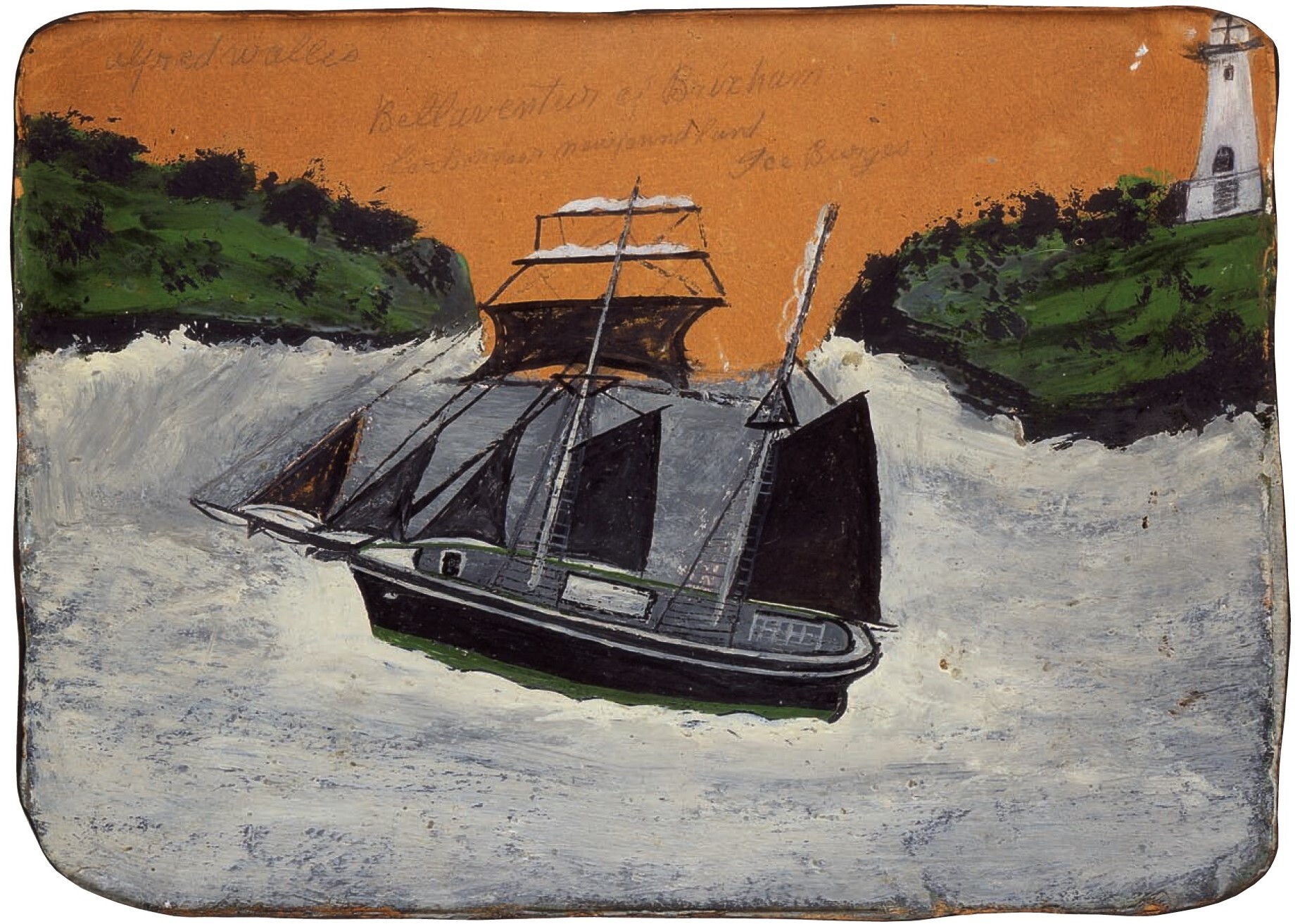
It was after leaving Batteau in October 1876 that his ship, the Belle Aventure (depicted with black sails above left), encountered a severe storm in the middle of the Atlantic Ocean. He and his fellow crew mates only survived by throwing a large part of the cargo of fish into the sea. Sadly his friends on the Recruit, which had left the day before, were lost in the storm without trace - a tragedy Wallis talked of for the rest of his life.
Wallis was at sea from May to November 1876, and the harrowing experiences he underwent led him to give up life as a merchant mariner as soon as he returned home to Penzance. Life was tough and dangerous on the small, two-masted topsail schooners that traded across the Atlantic.
He was an Ordinary Seaman, which was the lowest rank on the ship, and meant his quarters were in the cramped, dank and dirty forecastle beneath the deck at the prow of the ship. Shipwreck was commonplace, partly due to overloading of cargoes by unscrupulous owners, and it wasn’t until shortly after Wallis left the sea that the maximum-load line introduced by Samuel Plimsoll in 1876 was enforced.
His life at sea sounds really gruelling! Coming to his art work, is it true that he took up painting after his wife died? When was this?
It is often misquoted that Wallis ‘took up painting for company after the death of his wife’. Susan died at St Ives in 1922 and there is no doubt her loss affected him deeply. Sven Berlin, who first wrote about Wallis in the 1940s, was told by Wallis’s friends that he started painting in August 1925, telling them “I dono how to pass away time…I think I’ll do a bit’a paintin’ – think I’ll draw a bit”.
The year 1925 is significant. Up to this year, his birthday has been celebrated by the Tate and Kettle’s Yard on 18th August, but his birth certificate shows he was born on 8th August, and he would have turned 70 on that date in 1925, making him eligible for the Old Age Pension. Having worked all his life, receiving a pension meant Wallis finally had a reliable income, and his thoughts had turned to finding himself a hobby. The reason he chose painting, and the inspiration for his work, are detailed in the latter part of the book which looks in detail at his time as an artist.
He seems to have only had one style of painting. Would you agree? Is there much evidence that his approach or style changed?
Yes, I would agree. Having seen a large number of his paintings, I can discern certain elements that reveal from which period the work belongs to, but by and large his style and approach remained the same. His subject matter remained constant too. It is interesting to note that he was painting other subjects besides ships and boats from very early on, particularly scenes of houses, and he drew the same subjects in the sketchbooks he filled in when he was in the workhouse at Madron in the final year of his life.
Throughout his 17 years of output from 1925 to 1942, Wallis used the same supports of cardboard and paper, and the same boat paints made by Peacock & Buchan. This is an interesting point because it is often stated that he used these materials due to lack of funds, but my research shows they were conscious design choices. Even when he was in the workhouse, for example, Wallis asked for his usual boat paint to be brought to him from his supplier in St Ives.
Overall, it can be said that Wallis executed his paintings in a style wholly his own, without regard for any art movement, and I believe this is why they still hold such great appeal for each new generation of admirers.
I have a sense that Jim Ede was probably the most supportive of the artist-collectors that he met. Certainly he seems to have bought large numbers of paintings that have ended up at Kettle's Yard. Can you comment on this and on the support he did (or didn’t) receive from other artists?
This is a difficult topic that many people ask me about, and many have speculated on ever since Sven Berlin first raised it in his 1943 Horizon article. In attempting to write as complete a biography about Wallis as possible, I felt the need to address this issue head-on, so it underpins the latter part of the book.
I uncovered evidence in original material from Jim Ede, Ben Nicholson, Margaret Mellis, Sven Berlin and others to show that the support Wallis received did not equate to his increasing artistic standing in the British Modern Art world during his lifetime. I’d love to share more here, but I think it’s important to allow readers to come to their own conclusions. To this end, I have presented the contemporary evidence in as balanced a way as possible in the book, to allow the facts to speak for themselves.
How do you feel about the book now, and what do you hope it will offer readers?
I loved every aspect of the eight years it took to research, write, and produce this biography. It was deeply rewarding to uncover so much new information about Alfred Wallis’s life and to use those insights to reinterpret some of the paintings I first encountered at Kettle’s Yard back in 2017. TJ Clays in Padstow did a wonderful job printing the hardback, with beautifully faithful colour illustrations - I'm absolutely delighted with the result. More than anything, I hope the book offers a fuller, more accurate picture of Wallis - not just as a painter, but as a loving family man who lived through enormous hardship and was able to express this late in life through his paintings. If readers can come away seeing his work with fresh eyes - seeing not just the charm but the strength and experience behind them – I’ll feel truly glad.
Alfred Wallis: Child Pauper to Artistic Luminary by Matilda Webb is available here: https://www.alfredwallis.co.uk
St Ives Local magazine July/August issue 2025
article on Alfred Wallis Child Pauper To Artistic Luminary
Alfred Wallis is one of St Ives best-loved artists. His paintings greatly influenced Britain’s early Modern Art scene and are enduringly popular today. He was born in Devon to Cornish parents whose ancestors were firmly rooted in West Cornwall and the Isles of Scilly. He returned to his native land as a young teenager, having survived an impoverished childhood in the slums of Devonport. Such resilience was to aid him in times of hardship, particularly in battling great storms on the Atlantic Ocean in small, topsail schooners. Not long after these harrowing experiences, Wallis gave up life at sea and settled in Penzance with his wife, Susan Ward, and her five children.
In 1882 Wallis and his family moved to St Ives where he ran a marine stores business in the building which is now the Lifeboat Inn. But as the sea would flood the ground floor of the business at especially high tides, they soon moved to the top of a steep lane in Downlong, and eventually to a large premises on the Wharf.
Wallis would set out around the town with a cart pulled by his donkey Neddy, and later his pony Fairyfoot, while he called out “Rag-a-bone! Old Iron! Old Iron! Rag-a-bone!”. People took to calling him Old Iron, and as nicknames were an important feature of St Ives society, it shows that although Wallis was not a St Ives man, he had become part of the town.
Wallis and his wife retired to a small cottage in Back Road West. It was here he took up painting as a hobby in 1925, at the age of 70. Three years later he sold some of his work to two young artists, Christopher Wood and Ben Nicholson, after which he went on to paint prolifically. He sold most of his work to friends and patrons of these two artists, all of whom were prominent writers, critics and collectors in the British Modern Art world.
Despite the acclaim he received both at home and abroad, Wallis made very little money from his paintings. In 1941, destitute and gravely ill, he was taken to the workhouse, which by then had been renamed Madron Public Assistance Institution. After his death on 29 August 1942, his family funeral at Barnoon Cemetery was interrupted part-way through by his admirers, who then organised a private grave and second funeral, described as “a queer little ceremony”. Wallis’s grave lay bare and unmarked for a year and a half until the potter Bernard Leach suggested he make a set of decorative tiles to cover it. Thus Leach created a beautifully unique and fitting memorial for Wallis that can still be seen today.
In Alfred Wallis Child Pauper To Artistic Luminary, author Matilda Webb brings together a wealth of newly discovered information about both the life and works of this fascinating figure. She reveals Wallis’s turbulent life story and challenges the prevailing narratives surrounding his interactions with the ‘real artists’ who championed his work. St Ives Archive has played a significant role in providing access to original source material about the town of St Ives in Wallis’s day, for which the author is extremely grateful.
Alfred Wallis painted autobiographical events close to his heart. The key to understanding his paintings is to understand his life, and this richly illustrated biography offers many new insights to do just that.
Atmosphere Press website August 2025
Interview with Matilda Webb, author of Alfred Wallis Child Pauper to Artistic Luminary
Ever since she could hold a book, Matilda has loved reading, and when she met Roald Dahl at the age of seven, she was completely spellbound. That magical encounter planted a seed: one day, she would be a writer too.
As a teenager, Matilda divided her time between galloping across stubble fields on horseback, getting lost in books, and scribbling down her own stories. She went on to study archaeology at university, which led to adventures on digs around the world. Eventually, she returned to the UK, swapping trenches for museum galleries, all while continuing to write.
Matilda’s fiction is steeped in the past, from rebellious Roman teens to the quiet mysteries surrounding Stonehenge. But her latest book, Alfred Wallis: Child Pauper to Artistic Luminary, takes her in a bold new direction—into biography. Long fascinated by real lives, she was irresistibly drawn to Alfred’s remarkable story: a self-taught artist who rose from poverty to become a key figure in British Modern Art, yet ended his days in the workhouse. His life was too extraordinary not to explore—and too important not to share. The book is available now at www.alfredwallis.co.uk.
What inspired you to start writing this book?
I was first drawn to Alfred Wallis for his distinctive paintings, but with my background in historical research, on discovering more about his story I knew there was a really important and compelling human story to tell. Here was a man who endured profound hardship—child poverty, hard manual labour, and personal loss—yet in later life he began painting with a raw, instinctive brilliance that would go on to influence the course of British Modern Art.
Tell us the story of your book’s current title. Was it easy to find, or did it take forever?
The title, Alfred Wallis: Child Pauper to Artistic Luminary, appeared out of nowhere as I learnt more about the terrible conditions Alfred Wallis survived as a child in the slums of Devonport in the 1860s.
Describe your dream book cover.
I love the cover of my book—it is striking and uses austere colours, just like Alfred Wallis did in his paintings. The photograph of Wallis in the doorway of his cottage shows him standing slightly to one side as if he is inviting the reader in to hear his story.
What books are you reading (for research or comfort) as you continue the writing process?
There is a very long bibliography in my book! For the last eight years of research for this project, I have read many fascinating books on art and on social history.
What other professions have you worked in? What’s something about you that your readers wouldn’t know?
My whole life I’ve been fascinated by books, archaeology and museums, and have steered my career to work in all three areas. I also love travel and adventures and lived with nomads in Mongolia for a year.
Who/what made you want to write? Was there a particular person, or particular writers/works/art forms that influenced you?
When I was seven, Roald Dahl came to talk to my class. He asked us lots of questions about books and reading but I was the only one to put my hand up to answer each time. In the break he asked me to carry round a huge bowl of chocolate Maltesers and chatted to me. Afterwards he signed my copy of Charlie and the Chocolate Factory: “To Matilda Love Roald Dahl.” He was my first inspiration and I will never forget that wonderful encounter.
What advice would you give your past self at the start of your writing journey?
The advice I would give myself eight years ago when starting work on the Alfred Wallis book, would be to prepare in advance for my reaction after finishing it. I was caught off guard by the burnout and sense of loss I experienced after its completion and launch in May 2025.
What’s one thing you hope sticks with readers after they finish your book?
I really hope readers can come away seeing Alfred Wallis’s paintings with fresh eyes—seeing not just the charm but the strength and resilience behind them.